Monday, May 6, 2013

Topkapi!

Istanbul just keeps on giving. Topkapi Palace is full of intrigue -- emperors, sultans, concubines,  harems, eunuchs, many wives (isn't one wife work enough?), politics, royal families. It was a symbol of power for the Ottoman empire, and when the empire finally collapsed after World War 1 (around the time my grandparents left Turkey), the new government turned the palace compounds into a museum. All this commotion and drama would have made for a great HBO series. Now Topkapi is a World Heritage Site.

After standing in line with the hordes to buy tickets, you enter the 500+ year old palace through the Imperial gates.  At every glance there are gardens exploding with tulips (Istanbul is a tulip center -- we were lucky enough to come at the last gasp of tulip season -- Holland has nothing on Turkey when it come to tulips). Tulips feature so much in Turkish, they're reflected everywhere, from tile walls (of the palace and more), painting, pottery and such. There were no furnishings in the room, so it was hard to figure how the endless hallways and rooms fit together (a little eavesdropping on some group tours explained a little).

Of course, palaces usually boast the best real estate, so the views of the Bosphorus were breathtaking (even through a somewhat smoggy haze). There are plenty of places to get lost in the Palace which had numerous additions over the centuries. And at one point Adina and I lost each other for about 30 minutes. We eventually ran into each other just as I was formulating my plan about escape back to our hotel room.

We decided to forgo the extra visit to the Imperial Treasury because the line to get in was crazy long, wrapping itself around an entire courtyard. It was too hot and we were getting hungry.

As we were leaving we noticed generator trucks and scurrying about for some soft of event. Crews were setting up for Istanbul's jazz festival event for the next evening.


Loco for Loukma.


Hot fried dough orbs bathed in sweet syrup. That's an entire food category that makes me giddy. I still have memories of Indian Gulab Jamun in Jaipur...
This was sold as street food on my Bosphorus cruise stop. I bought them as we were leaving to board the ferry on its return. I ate a few. Adina gobbled a couple. A few "popped out" of my little dish in route and the rest I gave to a surprised but happy stranger while we waited to board the ferry. 
For many years I've made my version of loukma, which is called Bimuelos -- I even published one a few years ago in HOUR Magazine as a Sephardic Chanukah treat.


Here is my story (just click on the link). 


Bimuelos (or Loukma in Turkish)

Foods fried in oil are allegorical and traditional during Hanukkah. Most American Jews are of Eastern European descent and are known as Ashkenazim. Latkes, (fried potato pancakes) are the American “it” food at Hanukkah. Like their German or Polish relations, latkes stem from the culinary traditions of these countries.
Jews who settled in Spain and Portugal, are referred to as Sephardim. The Spanish Inquisition scattered Sephardim to, among other places, what is now Greece and Turkey, where other cooking styles were adopted. Among these are fried sweets called bimuelos, small yeast fritters, drizzled with honey syrup.
Bimuelos
Vegetable oil for frying
Batter
1/2 cup warm (105-115 degrees) water
1 packet (about 2 teaspoons)
active dry yeast
1 teaspoon sugar
2-1/4 cups flour
1/4 teaspoon salt
Another 1/2 cup warm water
1 large egg
Honey Syrup
1/2 cup sugar
1/2 cup honey
1/2 cup cold water
1 tablespoon lemon juice
Prepare the batter: Combine water, yeast, and sugar in a large bowl. Allow the mixture to sit until it becomes foamy, about 5 minutes. Add the remaining batter ingredients and, using an electric mixer, beat until uniform. Cover the bowl with plastic wrap or a damp (not wet) towel and allow the batter to rise for 1 hour.

While the batter is rising, prepare the honey syrup. Combine all ingredients in a saucepan and slowly bring to
a boil over medium-high heat. Cook until sugar dissolves. Remove from heat and allow
to cool.
Fry the batter: Line a baking sheet with several layers of paper towel.
Heat about 2 inches of oil in a large saucepan over high heat, to 375 degrees. Use one spoon to scoop up a small amount of batter. Use another spoon to form the batter into a ball while dropping it into the oil (do not crowd the pan). The fritters will puff and rise to the surface of the oil. Cook 1-2 minutes, turning them in the oil to cook all around.
When cooked, transfer the bimuelos to a bowl and drizzle with the syrup. Serve hot or warm. Makes 12 servings.

Spice Girl.

One benefit of the Bosphorus cruise is that you end up where you started, right in Eminönü.  What this means to foodies (and non-foodies) is the Istanbul Misir Carsisi, the old Egyptian Market (Misir mean Egypt and coincidentally  "corn" -- the food on a cob). This is the holy grail of markets -- the famous spice market. It's big, it's bustling and it's an amazing photo experience. Every spice you can imagine (and some I've never heard of) is represented here. 

But it's not all spices -- it's food (nuts, dried fruits),  typical bazaar stuff -- knickknacks, souvenirs. What comes with these all these stalls selling are the owners of the shops, each wanting you to "give me a chance" to sell you their wares. Nothing turns me off from shopping than someone forcing me to do it. Besides, I still have spices I brought back from my Morocco adventure in 2001 (now they are just souvenirs -- I promise I'll throw them away when I get home). And a friend, recently returned from India, brought me some fresh spices I still haven't broken into). 

Spices have a limited shelf life. They don't get rancid or anything, they just become dull. And dull spices, like dull people, just aren't that desirable. 

Still, the spice market Misir Carsisi is worth the visit. If you don't buy the spices (or candy, nuts or dried fruits), or anything else here, don't worry, you'll find it again and again and again at every farmer's maket, street corner, other bazaar or little shop, all over town. 

On the periphery of the market you can buy live birds, bunnies, guinea pigs and other assorted pets and pet paraphernalia, as well as 


Saturday, May 4, 2013

More for us on the Bosphorus.


According to my friend Ebru, no trip to Istanbul is complete without a cruise along the Bosphorus. If you take the tram (3 Turkish Lira (TL) = <$1.70) -- go to the Jetonmatik machine in the near the tram stop and insert your lira and out comes a red plastic token. When the tram doors open, pile in fast (there's no politeness when it comes to boarding a tram -- as people shove in, others snake their collective way out). Stand holding on to what you can. The cars are immaculate. Take a few stops to Eminönü ferry dock, pay your 25 TL for a half-day cruise and get on.

The ferry is three floors, so we scurry to get the best seats on the top deck. No deal -- the seating is first come, first serve, so if you want a coveted seat on the top deck, go early. I stand for about 40 minutes -- it's chilly up high -- before going down a level to inside seating and find Adina.

We serpentine back and forth a few times from stop to stop picking up other travelers. The air is fresh in an otherwise smog hazed city.  A ruckus -- look at the water -- dolphins! The ferry passes under suspension bridges connecting Europe and Asia. Along the way are universities, Istanbul Modern Museum, tidy mansions and houses built tall, not wide (very Amsterdam-like), along the banks. 

Onboard, the ferry company will sell you snacks or tea (vendors walk around with both). The favorite snack of the masses seems to be yogurt cups with packets of powdered sugar for sprinkling. While American kids want Twix, the Europeans and Asians want the yogurt. 

After about 90-minutes you end up at Anadolu Kavağı, on the Asian side Istanbul where everyone must disembark. For two hours you can wander the quaint streets and walk very-uphill to the "fort." OR, you do what we did -- have lunch. We picked a restaurant that was frying, battered mussel kebabs and grilling fresh whole mackerel that looked and smelled irresistible. And it was. 

Fried Mussel Kebabs
I'm not sure what they used for batter, but this "eggy" version works. And, since I'm thinking in US terms, I'm using ingredients available stateside. 

1 pound fresh shelled mussels
1 cup flour
1 tsp. salt
1/4 tsp. ground cayenne pepper (or other hot pepper)
4 large eggs, lightly beaten
Water

Vegetable oil for frying

Dry the mussels with paper towel (if they are not dry, the batter won't stick to them). 

Set aside. 

Combine the dry ingredients in the bowl of a food processor and pulse once or twice to mix. Add the eggs and pulse to combine, to make a thin batter. If the mixture is too thick for dipping the mussels, with the motor running, add water, a little at a time. Let me batter rest  while you add about 1-inch deep of oil in a large, deep skillet (12-inch diameter), over medium-high heat to about 375-degreesF.

Pour the batter into a bowl. Add the mussels to the bowl and toss well to coat the mussels.  Thread the oysters onto 8-inch or 10-inch wood or bamboo skewers -- as many mussels as you like.

Cook the mussels for about 1 minutes until golden. Use tongs to turn the kebabs over and fry on the other side. Serve immediately with fresh lemon wedges. Alternately you may cook the mussels without the skewers. Serve immediately. Makes 4 servings. 


Friday, May 3, 2013

Sultanahmet: It's Where You Want to Be.

Istanbul is big and crowded. While guide books may say less, inhabitants of the city cite 17-million souls (or more) who live within its over 2000 square-mile city limits, ranking it as one of the largest cities in the world. The city is on two continents -- Europe and Asia.  That means that part of the city is European and the other part is Asian. The Bosphorus is a waterway that divides the city and flows between the Black Sea and the Sea of Marmara. And somewhere in there is the Golden Horn, a horn-shaped estuary.

From what I think I know (which could be completely misguided), my grandparents lived in an area called Pera (the other side) of Istanbul. More on that later. 


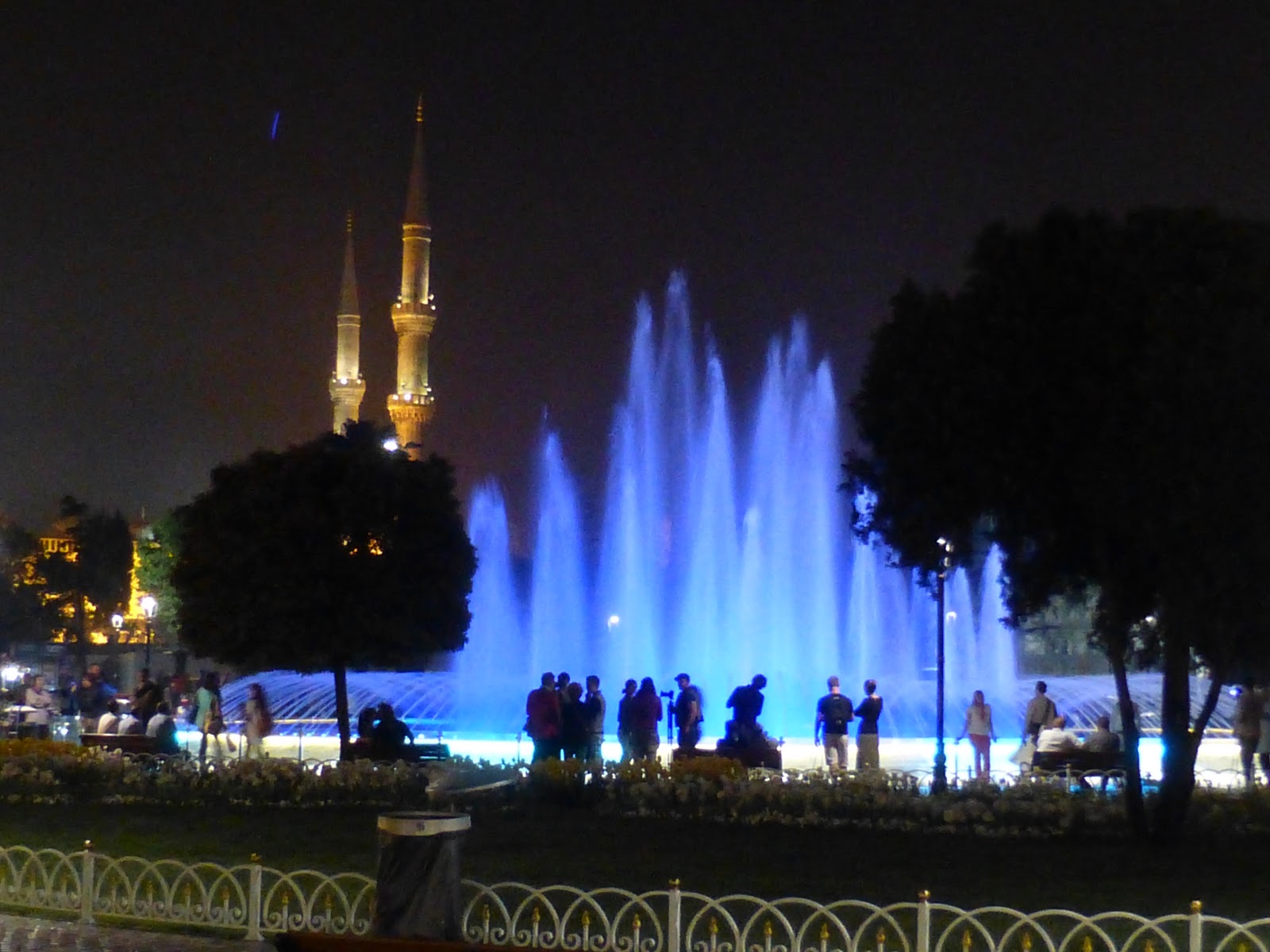
Sultanahmet, where we stayed, is the "old city." It's walled (or used to be), and you can still see much of that very wall, ubiquitous to all ancient towns of this ilk -- sometimes long stretches, sometimes just parts -- nearly everywhere you look. The most famous sites of the town are right here - mostly walking distance from each other. You've got your Blue Mosque (or its official name Sultan Ahmed Mosque), your Hagia Sophia, your Grand Bazaar, your Cisterns and, the most dazzling of all,  Topkapi Palace.  There's the center park with its enormous fountain which lights at night and changes the color of the water every few seconds. The park sits on what was the ancient Hippodrome. Not to mention there are seemingly countless other city sites and museums. 

The touristy part of the city is immaculate. No trash anywhere. Lovely benches and fountains. Amazing panoramas at every turn. And the Blue Mosque is the most photogenic of all. If Disney or Las Vegas had an Istanbul street or hotel, it would look this perfect. 

I'm not going to bore you with any guide book history of Sultanahmet (though it is fascinating), but this is tourist central, to be sure. 


Day 1: Dinner


We checked-in to our hotel overlooking the Bosphorus in Sultanhamet, the most popular tourist spot.  Exhausted, but because it was still early, 8-ish in the evening, we forced ourselves to stay up. So we went to dinner at a Metropolis, near our hotel. Adina ordered Iskender Kebab (Iskender means Alexander) and I the Vejeteryan Guvec (vegetable casserole). 

Anything "Iskender" comes the same way -- cooked in tomato sauce and pide (pita-type) bread in the sauce (the cooked bread reminded me of pasta or dumplings) and served with thick, plain yogurt. My Stew was eggplant, carrots, pearl onions, zucchini, tomatoes cooked and served bubbling hot in a clay dish, and topped with what the Istanbul folk call "yellow cheese." 


It is said that "hunger is the best sauce." And we were hungry and this was scrumptious. Served with a loaf of that same pide, or what I called bubbly bread.


Here is my version of the vegetable casserole.  


Turkish Vegetable Casserole

Casserole:
2 cups 1-inch cubed eggplant
2 cups 1-inch cubed zucchini
2 cups 1-inch cubed carrots

1 green or yellow bell pepper, cut into 1-inch pieces
2 cups 1-inch cubed tomatoes
2 cups button mushrooms, cut in half or quartered if whole
12-18 pearl onions (more if small, less, halved, if large), peeled, but left whole
1 tsp. minced garlic
1 cup tomato sauce
3 Tbsp. fresh lemon juice
3 Tbsp. extra virgin olive oil
Salt and pepper to taste

Garnish:
Shredded Turkish white cheese or feta cheese, crumbled

Preheat the oven to 400-degreesF. Combine all the casserole ingredients in a large bowl and toss well. Transfer to an attractive ceramic or glass baking dish and cover with foil. Bake for about 20 minutes. Remove foil, stir. Cook, uncvored, for 20-30 minutes more. Add salt and pepper to taste, stir again and serve immediately, with the cheese sprinkled on top. Makes 4-6 servings.

Istanbul Day 1: The drive from the airport.

Once we were on our way to our hotel, what should have been a short jaunt on a Saturday evening turned into a social studies class on Turkish weekend customs. Driving along the congested road hugging the Marmara Sea, is a long (miles, I'd say) park area. The park is lined with flowerbeds full of tulips. It's April and the tulips are in bloom, almost at the end of their glory.

In this park are families -- lots and lots of families, with children running and playing. The women, many dressed in traditional garb, were mostly sitting while the men had other duties. They all seemed to be doing the same thing -- grilling food. Delicious smelling lamb, vegetables and tomatoes, from what I could see, all on portable grills.

These small grills, burning wood or coal (it seems) were surrounded by families large and small and groups of friends. Every few feet -- another group/another grill. Some of the grills were store bought, others homemade. Smoked rising in tufts above the grills clouded our view as we slowly inched along in our black Mercedes van.  The scene reminded me of a modern Turkish version of Manet's painting "Luncheon on the Grass.


"

After traveling for 18 hours, I was tired and hungry and wanted only to get to our hotel. Yet, I still would have loved to join the local custom. The food - simple and humble - looked and smelled amazing.